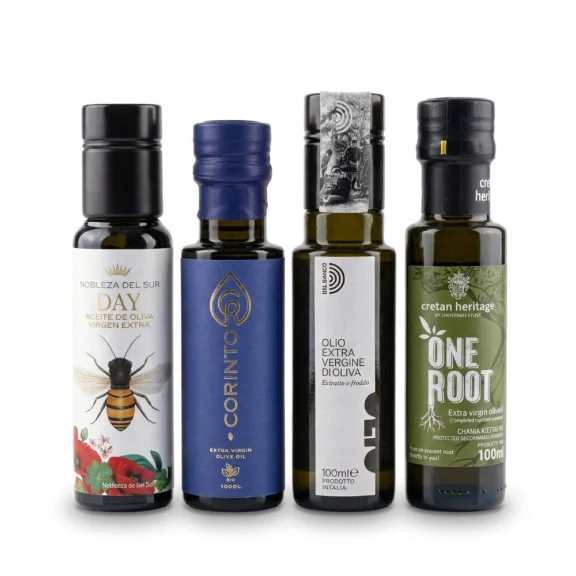
1. What the term means
“High-phenolic” has no legal definition. It is a marketing category for extra virgin oils whose polyphenol content is well above the 250 mg/kg needed for the EU health claim — in practice from about 500 mg/kg upward, with the top of the market above 1,000. The oils are made the way phenols are made: very early harvest from phenol-rich varieties, fast cold milling, often unfiltered, usually from dry-farmed trees. They taste the part — intensely bitter and pungent, a cough in the throat — and they are sold by the number.
The number is real when a laboratory produced it and the producer can show the certificate for the lot in the bottle. It is less real when it is a retailer’s figure, a “1,000+” band, or a company statement with no method. In this library we print all three kinds, with who said it; a bar on the meter means a measured figure, and a band or a claim gets text.
2. What the evidence says
The regulator’s position is modest. Regulation 432/2012 permits one claim — polyphenols “contribute to the protection of blood lipids from oxidative stress” — at 5 mg of hydroxytyrosol and derivatives per 20 g of oil. EFSA found the evidence for that effect convincing and for nothing more; the opinion is a threshold, and an oil at 300 mg/kg carries the claim as fully as one at 1,300.
Beyond that, the research is active and incomplete. Oleocanthal’s ibuprofen-like inhibition of COX enzymes was shown in 2005; studies on cognition, blood pressure and markers of inflammation exist, mostly small, some promising, few replicated at scale, and nearly all using daily amounts around the 20–40 g the claim assumes. Nothing here says a 1,200 mg/kg oil does something a 500 mg/kg oil does not, because nobody has run that comparison properly. What the figure reliably predicts is shelf life and taste.
3. The number decays
A polyphenol figure describes the oil the day it was analysed. Phenols are antioxidants and they are spent protecting the oil; storage studies put the loss at 30–50% over a year under normal conditions, less in a cool dark cupboard, more in light and heat, and faster in an unfiltered oil whose suspended water and fruit particles keep hydrolysis going. A certificate dated November for a bottle you open in July is describing a different oil — still good, but not the number on the label. Corinto says this plainly on its High-Phenolic listing; most do not.
The certificate is for the lot the laboratory saw, on the day it saw it.
4. Five things to check
| Check | Good sign | Weak sign |
|---|---|---|
| Method named | HPLC or NMR, laboratory named | No method; “1,000+”; “among the highest in the world” |
| Lot and date | Certificate dated, harvest year on the bottle | A figure from a previous year’s lot |
| Harvest | September–October, stated | Not stated |
| Variety | A phenol-rich variety named | Unnamed blend |
| Taste | Bitter, pungent, makes you cough | Mild — a mild oil at 1,000 mg/kg is a contradiction |
What separates a certified high-phenolic oil from a label that borrowed the phrase.
5. Who should buy it
If you like intense, bitter oil and use it raw — on greens, pulses, grilled meat, by the spoon — a certified high-phenolic bottle is a fair purchase and a long-lived one. If you cook with oil or prefer it soft, you are paying for a number you will not taste and a claim an everyday extra virgin already carries. The best value in the category is usually a producer’s own early-harvest from a rich variety at 600–800 mg/kg, sold without the word “high-phenolic” on the front.