Sarıulak
also called Sarı Ulak (open spelling used in academic work)The one Turkish variety here with a full protected-designation specification giving hard numbers — and they make an unusual pair: comparatively low oleic acid at 65–70%, alongside total phenols of 600 to 836 mg/kg.
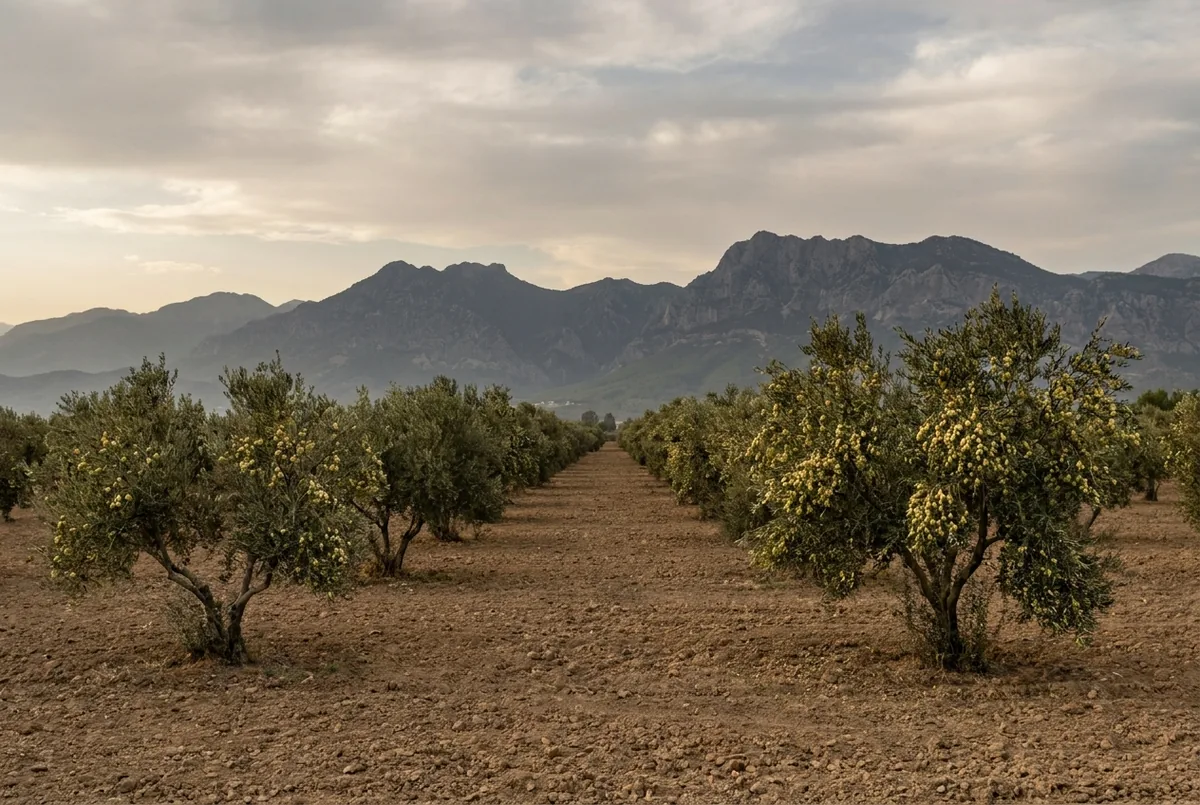
| Also called | Sarı Ulak (open spelling used in academic work) |
|---|---|
| Main regions | Mersin (Tarsus, Silifke), eastern Mediterranean |
| Purpose | Dual-purpose, oil-leaning |
| Oleic acid | 65.6–70.1% |
| Oil yield | 18.7–19.6% of fruit weight |
| Harvest | Through to late January |
| Designations | Tarsus Sarıulak Zeytinyağı (Turkish PDO no. 767); Tarsus Sarıulak Zeytini |
In the grove
Aroma and flavour descriptors
No descriptors are published for Sarıulak oil. The PDO specification describes only a bright yellow colour and omits formal fruity, bitter and pungent descriptors. No panel medians published. We do not infer them from the fruit or from related varieties — 40 of the 40 varieties here are in the same position.
This shelf fills when the panel scores an oil made from this variety. 19 of the 40 varieties here are in the same state today.
Sarıulak against the other Türkiye varieties
| Variety | Origin region | Used for | Polyphenols | Shelf stability |
|---|---|---|---|---|
| Ayvalık | Edremit Gulf, Balıkesir | Oil | Not published | Not published |
| Memecik | Muğla, southern Aegean | Dual-purpose | 296–407 mg/kg | Not published |
| Gemlik | Gemlik, Bursa, southern Marmara | Dual-purpose | 244–491 mg/kg | Not published |
| Domat | Akhisar, Manisa | Table | ~351 mg/kg (single study) | Not published |
| Uslu | Akhisar, Manisa | Table | ~163 mg/kg (single study) | Not published |
| Nizip Yağlık | Nizip, Gaziantep, southeastern Anatolia | Oil | Not published | Not published |
| Sarıulak | Tarsus, Mersin | Dual-purpose | 602–836 mg/kg | Not published |
| Erkence | İzmir — Karaburun, Urla, Seferihisar | Dual-purpose | ~87 mg/kg | Not published |
Sources
- Tarsus Sarıulak Zeytinyağı PDO specification, Türk Patent
- Olive cultivars as seedling rootstocks, Horticultural Studies
Every figure on this page carries a source. Where we could not find one we say so rather than estimating. Corrections are welcome and credited.